

Mathematics
What is best in mathematics deserves not merely to be learnt as a task, but to be assimilated as a part of daily thought, and brought again and again before the mind with ever-renewed encouragement.”
Bertrand Russell
The intent of our mathematics curriculum is to nurture each student's mathematical prowess so that every student reaches their full potential. We view mathematics as a profound human endeavour that shapes our understanding of the world, transcending time and culture.
Our curriculum aims to cultivate mathematicians through four key processes:
- Knowledge Acquisition: Sequencing learning to deepen understanding, to build on prior knowledge, and to develop mathematical language.
- Fluency: Practising diverse, complex problems in order to enhance conceptual understanding, and accurate application.
- Generalisation: Encouraging reasoning and relationships, and crafting arguments using mathematical language.
- Application: Solving varied problems and applying mathematics across subjects and real-world scenarios.
We challenge students to embrace ambiguity, persevere through difficulties, and to appreciate mathematical beauty. By fostering creativity and curiosity, we hone critical thinking and abstract reasoning skills.
Our approach promotes mathematics as an intellectual pursuit that transforms minds, thus equipping students to tackle profound challenges and offer unique perspectives on our world.
Subject: Mathematics
Jump to Year Group:
Year 7
|
Autumn 1 |
Autumn 2 |
|
Place value ordering integers and decimals Understand algebraic notation Sequences |
Equality and equivalence Fraction, decimal and percentage equivalence Solving problems with addition and subtraction |
|
Spring 1 |
Spring 2 |
|
Solving problems with multiplication and division Fractions and Percentages of Amounts |
Operations and equations with directed numbers Constructing measuring and using geometric notation Developing geometric reasoning |
|
Summer 1 |
Summer 2 |
|
Addition and subtraction of fractions |
Developing number sense Sets and probability Prime numbers and proof |
Year 8
|
Autumn 1 |
Autumn 2 |
|
Ratio and scale Multiplicative change Multiplying and dividing fractions |
Working in the Cartesian plane Representing data Tables and probability |
|
Spring 1 |
Spring 2 |
|
Brackets, equations and inequalities Sequences |
Fractions and percentages Number sense Angles in parallel lines and polygons |
|
Summer 1 |
Summer 2 |
|
Indices Standard form |
Area of trapezia and circles The data handling cycle Measures of location |
Year 9
|
Autumn 1 |
Autumn 2 |
|
Straight line graphs Forming and solving equations Testing conjectures |
Three dimensional shapes Numbers Using Percentages |
|
Spring 1 |
Spring 2 |
|
Maths and money Deduction Enlargement |
Rotation and translation Pythagoras Theorem Similarity Solving ratio and proportion problems |
|
Summer 1 |
Summer 2 |
|
Rates Algebraic representations |
Probability Congruency Constructions |
Year 10
|
Autumn 1 |
Autumn 2 |
|
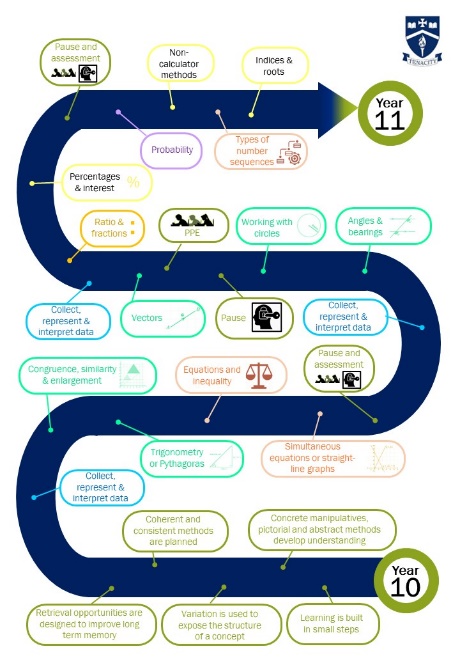
Collecting, representing and interpreting data Congruence, similarity & enlargement HC Trigonometry or F Pythagoras |
Equations & inequalities HC Simultaneous Equations or F Straight line graphs |
|
Spring 1 |
Spring 2 |
|
Collecting, representing and interpreting data Angles and bearings Working with circles |
Vectors Ratios and fractions Percentages & interest |
|
Summer 1 |
Summer 2 |
|
Collecting, representing and interpreting data Probability |
Non-Calculator Methods Types of Number and sequences Indices & Roots |
Year 11
|
Autumn 1 |
Autumn 2 |
|
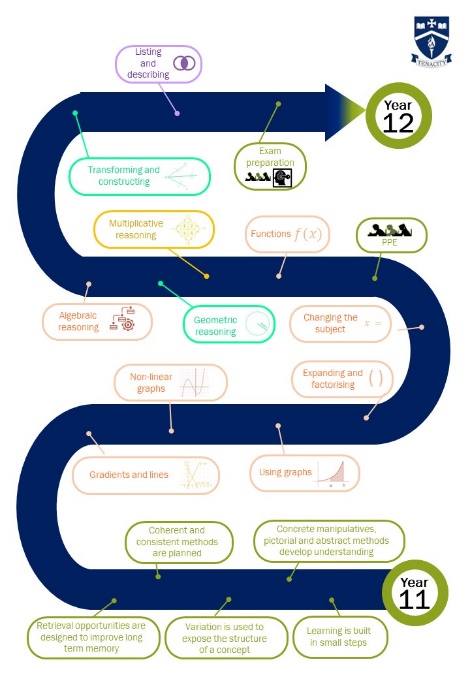
Gradients & lines Non-linear graphs Using graphs |
Expanding & factorising Changing the subject Functions |
|
Spring 1 |
Spring 2 |
|
Multiplicative reasoning Geometric reasoning Algebraic reasoning |
Transforming & constructing Listing & describing |
|
Summer 1 |
Summer 2 |
|
Revision and Exams |
Revision and Exams |
Welcome to the Mathematics department at Churchdown School
We are a large department with different life and teaching experiences. We each bring our own set of skills to the team and work collaboratively to combine all our strengths and expertise.
Mathematics Curriculum
We believe that students are entitled to an inclusive, accessible, and ambitious mathematics curriculum which prepares them for everyday life. Our aim is to build students’ confidence, so they can approach problems with resilience and determination. Making mistakes is to be seen not as a failure but as a valuable opportunity for new learning.
Students learning journeys are sequenced to build on prior knowledge, with concepts interweaved and opportunities to retrieve knowledge built in. We develop students’ acquisition of mathematical language throughout their maths journey at school to deepen their understanding of mathematical concepts. Our curriculum is not restricted to the National Curriculum, we spend time focusing on hinterland concepts that expose the structure of mathematics to give our students a flexible understanding that can be extended to problem solving.
To achieve a depth in understanding we follow the principles of teaching for mastery and evidence informed practices. Key concepts are broken down into connected small steps to reduce cognitive overload and improve working memory. Opportunities are embedded for intentional rehearsal and retrieval practice to improve student learning.
Our curriculum design is evidence informed, we adapt high quality resources from NCETM, White Rose and Sparx to enhance our pedagogy and enact our curriculum goals. Connections within mathematics are emphasised, which helps to ensure that students’ learning is sustainable over our 5-year curriculum. Our aim is for all students to gain sufficiently deep and secure understanding of mathematics to form the foundation for future learning. We have a common lesson design and plan collaboratively to create the highest quality resources. To ensure equity time is spent designing scaffolding so lessons are accessible to all.
Within the curriculum we provide flexibility for teachers to personalise the learning for their class. We have ‘Pause’ topic which change each year to meet the current cohorts needs. Fixed topics are planned with flexibility to enable teachers to adapt to their class. Extra time is built in so a teacher can Pause to address misconceptions or work on gaps identified in pre-requisites.
Students receive personalised support via the online platforms we subscribe to. Our homework platform Sparx Maths uses AI to personalise each student’s homework task. Our curriculum is entered into the platform so homework recall knowledge recently acquired and previous learning. We provide a homework club before their deadline and catchup sessions after each week to support students. As the tasks are personalised and support is in place the expectation is for students to obtain 100% by the deadline. Deadline help students optimise retrieval at the point of forgetting to support long term memory.
Within a year students will have one formal assessment in the hall and up to two assessments in class. Our assessments are designed to familiarise students with the GCSE course preparing them for the language and assessment demands. All assessment data is entered into Pinpoint Learning which analyse student’s strengths and weaknesses and provides personalised support and informs teachers lesson planning.
We support student’s memory and retention using carefully created knowledge organisers that explicitly identifies vocabulary and facts required for each topic in the student’s journey. Quizzing and application are built into the knowledge organiser along with preparation for assessments. Knowledge organisers are embedded within our curriculum and teaching practice. At the back of the knowledge organiser are guides for revision, how to use our online platforms and the learning journey outline.
Y7 Knowledge organiser Y8 Knowledge organiser Y9 Knowledge organiser
Y10 Knowledge organiser Higher Y10 Knowledge organiser Crossover
Y10 Knowledge organiser Foundation
GCSE Express Higher KO GCSE Higher KO
GCSE Foundation KO GCSE Standard Foundation KO
KS3 overview
Our students follow a five-year curriculum that considers what comes before and after in their learning journey. We work with our feeder primary schools to ease transition into KS3. With our KS2 partners we look at coherent and consistent methods, areas for development and plan for pupils that are not KS3 ready. Our curriculum goes deeper than the National Curriculum as we see value in the journey beyond GCSE. We clearly map out the learning journey for students.
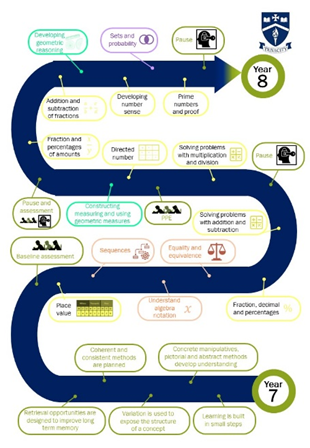
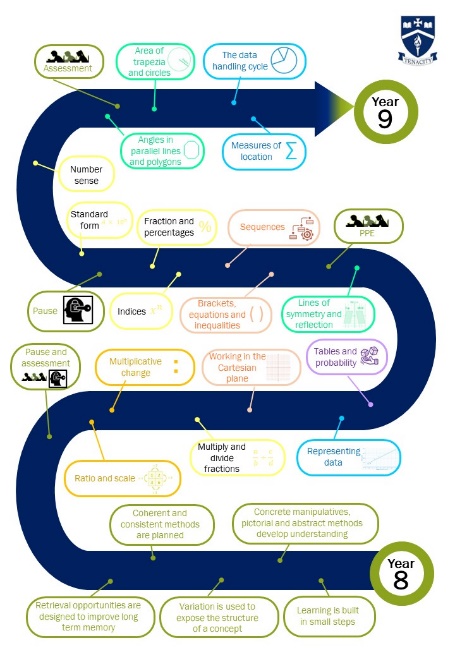
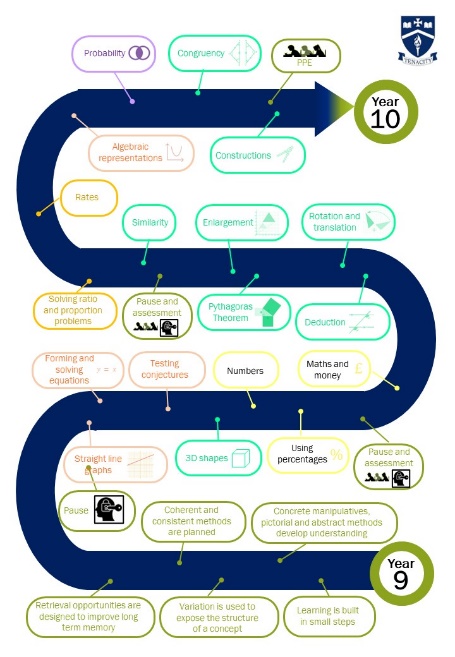
Our lessons are collaboratively planned to expose the structure of a concept. Lessons are designed with a scaffolded approach with concrete or pictorial representations that expose the structure that facilitate teaching for mastery so all pupils can access the content and are exposed to challenge. All classes are taught the same content and use the same collaboratively planned lessons. Our expert teachers adapt the lessons and design retrieval for the individual classes needs. Our teaching groups are a hybrid of mixed attainment. We group by pace to allow support and facilitate class discussions.
 We use common approaches to make links to same deep structure of concepts and reduce cognitive overload, for example ratio tables.
 We use concrete and pictorial representations to support pupils understanding. For example, negative numbers can be tricky and is often misunderstood so we use double sided counters to help pupils make sense of the concept.
Teachers live mark during the lessons so they can adapt and support students if needed. We use turn and talk, cold calling and class discussions to create an environment for pupils to make sense of their learning and ask questions.
KS4 overview
KS4 classes are designed to give flexibility so pupils can thrive and extend their knowledge. Tier entries are not decided in year 9 and flexibility is built in to provide opportunities for change where appropriate. Our curriculum explicitly outlines foundation, crossover, and higher content so teachers can adapt topics to the requirements of the class.
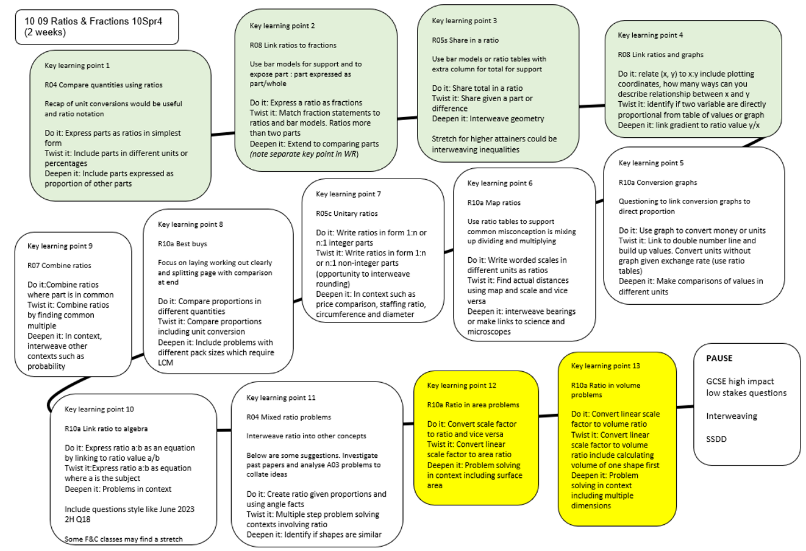
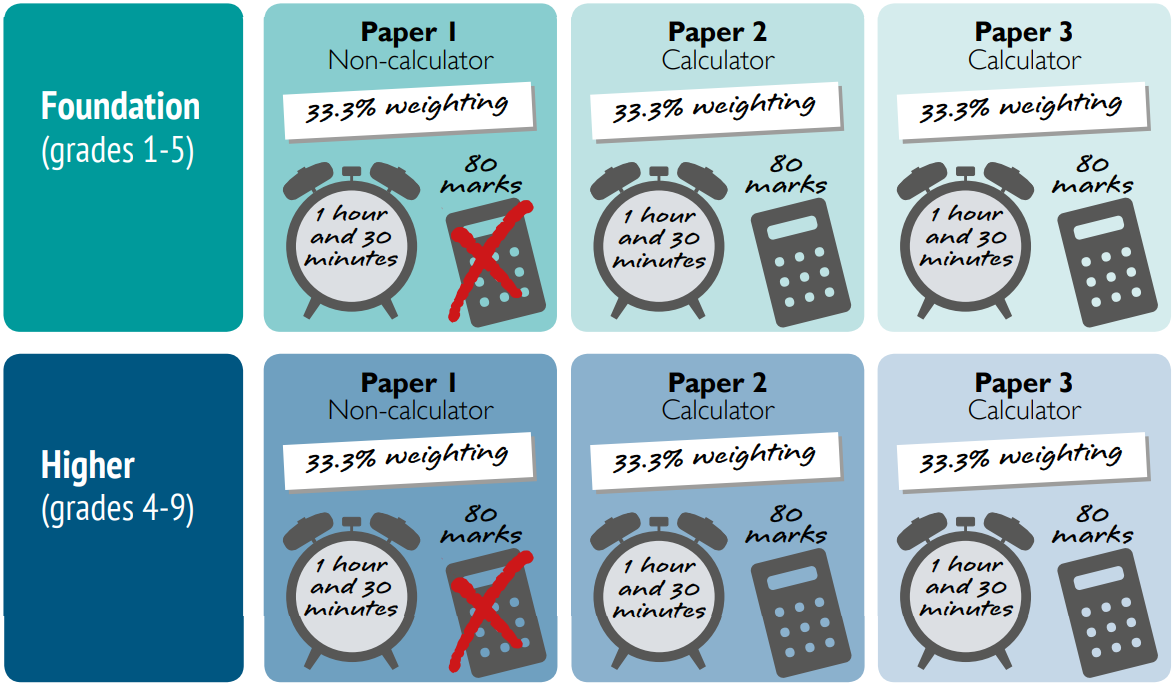
Edexcel GCSE (9-1) Mathematics take an innovative mastery approach to build students' confidence, fluency, problem-solving and reasoning in readiness for GCSE and beyond. The course is split into two tiers; higher (which covers levels 9-4) and foundation (which covers levels 5-1). The last half of the foundation paper makes up the first half of the higher paper, this is the crossover section. In the Summer of year 11, pupils will sit three examination papers.
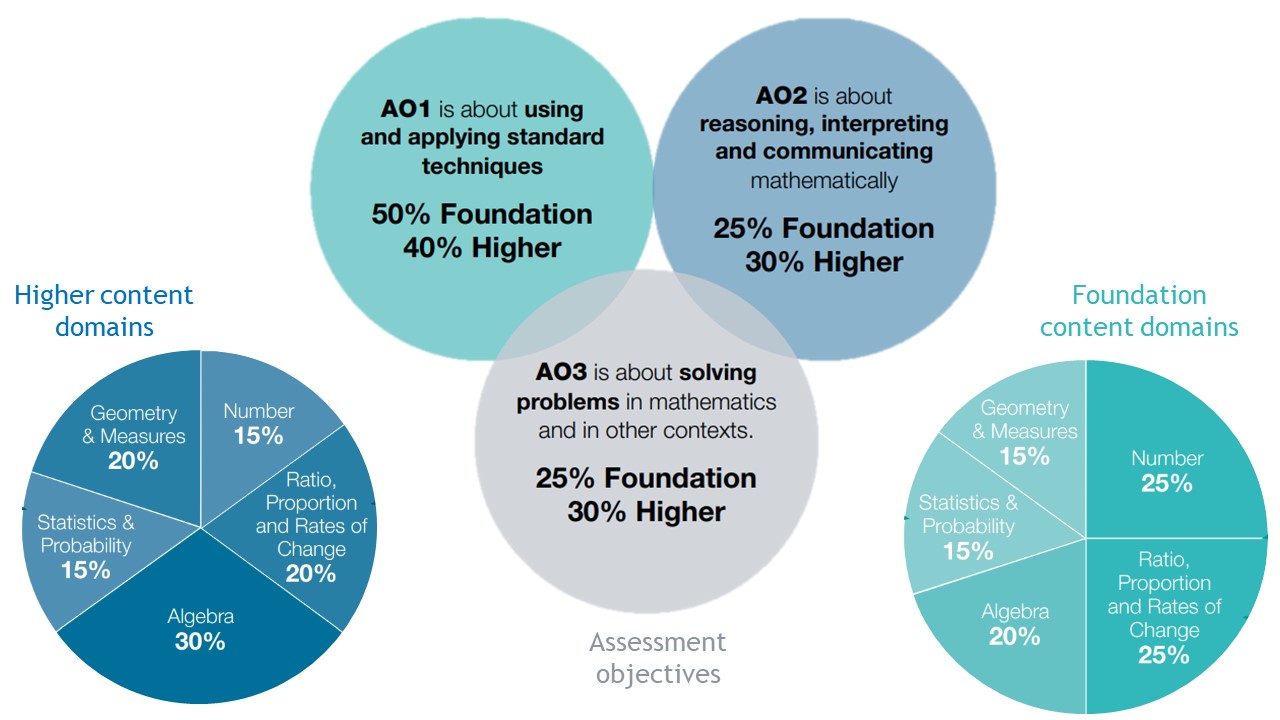
The weighting of the topic areas has been prescribed by Ofqual and is common to all exam boards. The diagram below shows the assessment areas and approximate weightings of the topic areas for the overall tier of assessment, not for each individual question paper.
Useful websites
https://www.pinpointlearning.co.uk/
https://corbettmaths.com/2016/03/10/how-do-i-revise-for-my-gcse-maths/
https://www.mathsgenie.co.uk/papers.html
https://corbettmaths.com/contents/
https://corbettmaths.com/2023/08/01/gcse-revision/
https://corbettmaths.com/5-a-day/
https://collins.co.uk/pages/revision-gcse-ages-14-16-collins-gcse-revision-and-practice-flashcards
https://www.transum.org/Maths/Activity/Calculator/
https://thecalculatorguide.com/help-with-your-calculator-2/
https://www.bbc.co.uk/bitesize/examspecs/z9p3mnb
A-level overview
The new A Level course consists of two Pure Mathematics units, and one Applied Mathematics unit covering both Statistics and Mechanics. Pure Maths counts towards 67% of the final mark and Applied is 33%. All the units are compulsory
A few of the topics from the GCSE higher tier are revisited at A level but, in general, pupils will be studying mostly new topics and a much wider syllabus. To prepare students for the course we provide a transition task to ensure they arrive in September confident and fluent in GCSE maths skills. Students are encouraged to sign up and complete the Transition to A Level course at https://amsp.org.uk/resource/supporting-students-transition-to-level-3-study
Edexcel Level 3 Advanced GCE in Mathematics (9MA0). Each unit is assessed by a 2 hour exam, worth 33.3% of the qualification, taken at the end of Year 13. There is no coursework.
More details of the curriculum can be found in our website here.
Extracurricular opportunities
Students will have an opportunity to take part in competitions and challenges such as the UKMT Maths  Challenge and CyberFirst Girls Competition.
Throughout the year the team provide various enrichment opportunities to appeal to all students. We have an exciting programme of activities from the Egg Drop Challenge to the Monty Hall Problem to engage and enthuse students.